The project was commissioned by Wageningen University & Research as part of the LEAPT research project.
The work was created in collaboration with scientist Frank Lee Harris, Donát István Kuti (composition and sound design), Otto Calmeijer Meijburg (voice-over), Dr. Stacy Pyett (text editing), Dr. Maaike Nieuwland, Remco Kluizenaar and Dr. Arjan Sterken (advice on mythology and folklore).
Perlijn was presented as part of the solo exhibition Between Breath and Bones at Kunstpodium T as part of the Murf/Murw festival and at BioArt Laboratories during Dutch Design Week 2025.
How a Bean Taught the Earth to Listen
Perlijn is a scenographic installation and mythic narrative about transformation, reciprocity, and the promise of a renewed relationship with the earth. Created as part of the LEAPT project (Local Engagement for Accelerating the Protein Transition into Practice) in collaboration with Wageningen University & Research, the work addresses the urgent need for a shift toward plant-based diets in high-income countries.
The installation is inspired by Pythagorean thought, where beans were said to house the souls of the dead and had a striking resemblance to the human embryo. Drawing from this physical kinship, a subtle nod to the Doctrine of Signatures where form reveals essence, the bean’s resemblance allows it to be reimagined not as a mere resource, but as a vessel for life and consciousness; a partner in a shared ecology.
Reclaming space
The installation unfolds through a contemporary fable, a story of a mysterious organism born into a world defined by utility. Found in a sheep stable but possessing no fleece, Perlijn is an unknown entity that exists outside of capitalist value or agricultural function. When the farmer, seeing no use for her, attempts to slaughter her, Perlijn escapes, returning to the earth to plant herself, eventually flourishing into the living cathedral that now surrounds the visitor. This origin story serves as an interruption to centuries of habit, marking the transition from consumption to communion.
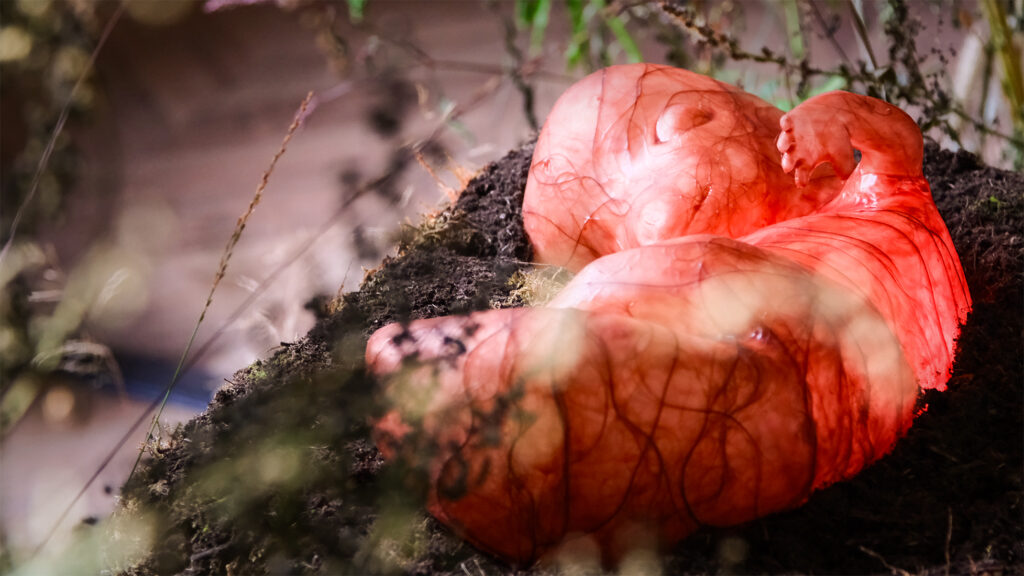
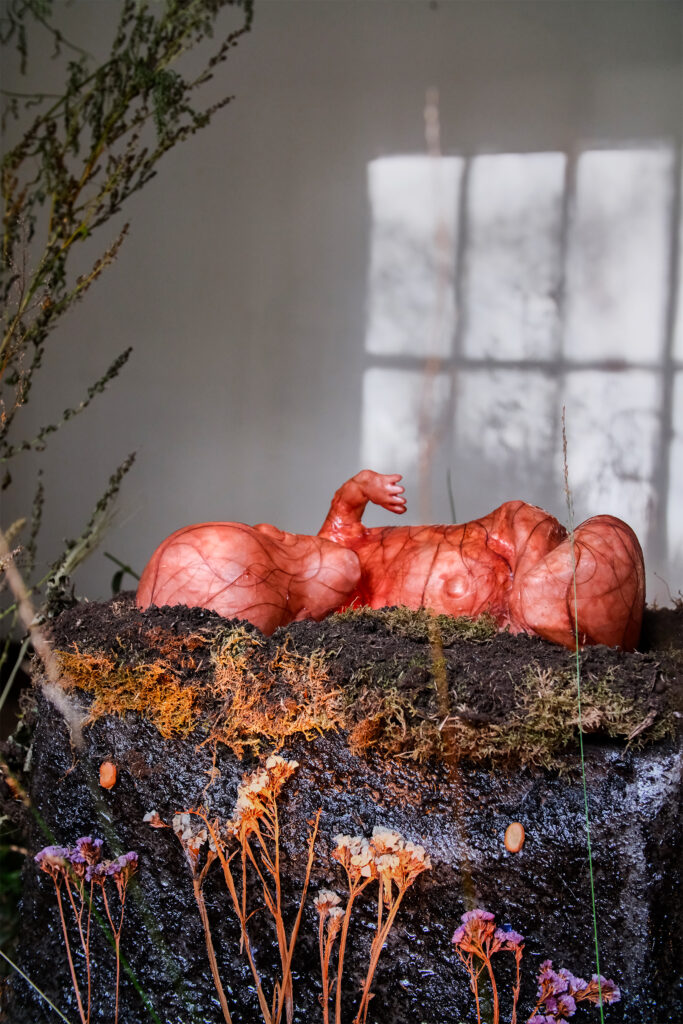
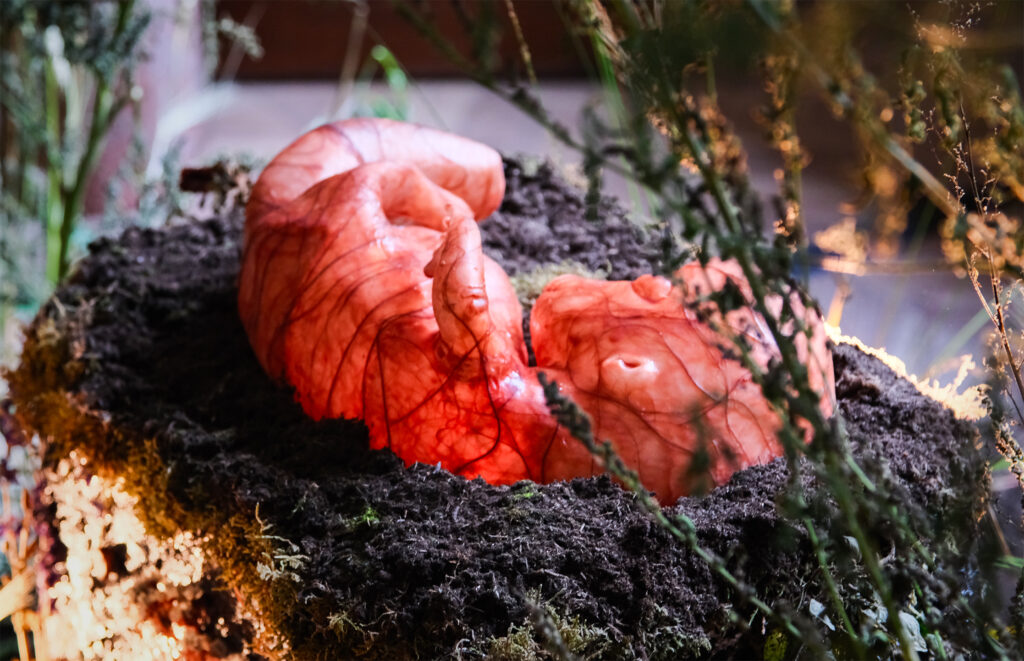
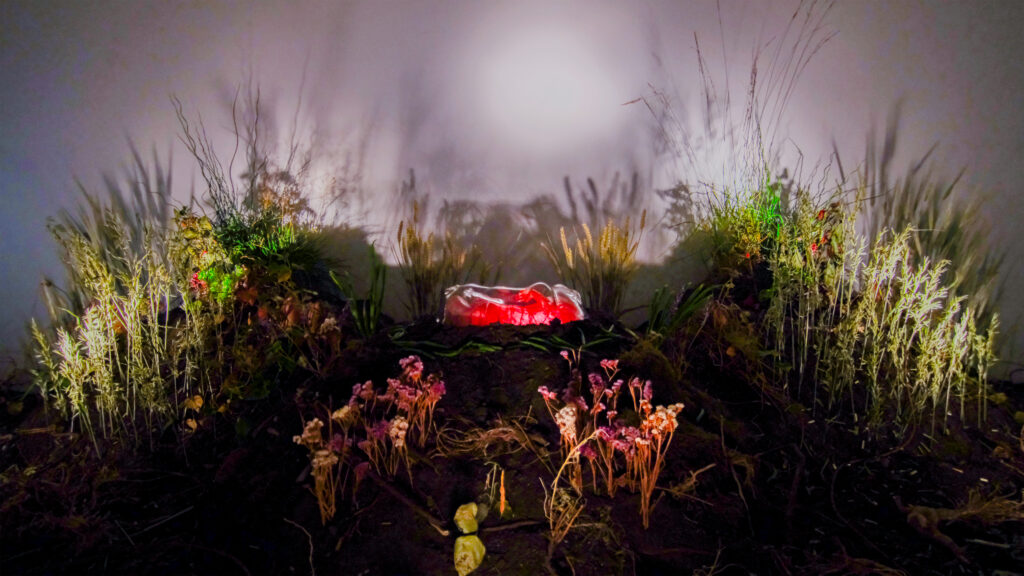
Visitors enter a room that functions as a ‘living cathedral,’ where the air is thick with the scent of damp earth and dried flora. At the center, atop an elevated altar, lies Perlijn: a 3D-modeled sculpture that pulses with a rhythmic light.
The altar acts as an Axis mundi, a sacred center connecting the subterranean depths of the soil to the heights of the sky. It is surrounded by a dense landscape of soil and a polyphonic arrangement of beans, crops, flowers, and grasses, both living and dried. This botanical diversity is used to make the concept of strip cropping tangible, visualizing a form of agriculture rooted in diversity rather than monocultural domination. As if the narrative is physically reclaiming the space, these various species entwine around the altar, showcasing the richness of the land. Depending on the setting, visitors are guided by a localized soundscape or headphones, immersing them in the origin story of the pod:
“One morning, as the mist still hung between the barns, a farmer found a strange body lying among the lambs in his stable. She had no fleece. Small and curled up, her skin was as soft as damp clay and her breath smelled of fresh beans. He named her Perlijn.”
The work is deeply informed by scientific research into the soil microbiome and the symbiotic intelligence of legumes, emphasizing the various biological layers and connections that sustain an ecosystem. This intelligence is mirrored in the installation’s narrative, describing a world where agriculture follows the rhythm of the earth rather than the grid of the machine:
“And from her a field began to grow. Not in squares, but in rhythm. One strip full of beans that whispered to the sky and brought nitrogen to the earth. The next with grasses that held water. And the last with flowers that settled at the edges. The roots recognized one another. They whispered through a glimmering network of fungi. They slowed and carried the breath of connection together.”
Through conversations with scientist Frank Lee Harris, the project explores how beans form partnerships with Rhizobia bacteria to fix atmospheric nitrogen, naturally enriching the soil and supporting diverse ecosystems through strip cropping. This biological synergy serves as the foundation for the installation’s message: a move away from industrial domination toward an agricultural imagination rooted in diversity. Perlijn suggests a re-ritualization of nourishment where eating is no longer an act of consumption, but a conscious communion with the living world.
Acknowledgements
The project was commissioned by Wageningen University & Research as part of the LEAPT research project. We would like to specifically thank Dr. Maaike Nieuwland, Dr. Stacy Pyett, and Remco de Kluizenaar for their trust, guidance, and collaboration in bridging artistic response with scientific inquiry. The work was created in collaboration with scientist Frank Lee Harris and Donát István Kuti (composition and sound design). Further contributions were provided by Otto Calmeijer Meijburg (voice-over), Dr. Stacy Pyett (text editing), and Dr. Arjan Sterken (advice on mythology and folklore).
Perlijn was presented as part of the solo exhibition Between Breath and Bones at Kunstpodium T as part of the Murf/Murw festival and at BioArt Laboratories during Dutch Design Week 2025. The underlying research and artistic response were also presented during a lecture at Wageningen University.