Of Boar and Fungi
A Nuclear Love Affair
2025 – 2026
This project is the result of a multidisciplinary collaboration with Bettina Stoetzer, whose ethnographic research forms the foundation of the work, and Åsa Sonjasdotter, as consultant.
The work is on show at Het Nieuwe Instituut from November 21, 2025, to August 9, 2026, as part of the exhibition FUNGI: Anarchist Designers, curated by Anna Tsing and Feifei Zhou.
This work was commissioned by Nieuwe Instituut. Funding has been generously provided by the Mondriaan Fund and the MIT Center for Art, Science & Technology (CAST).
Of Boar and Fungi
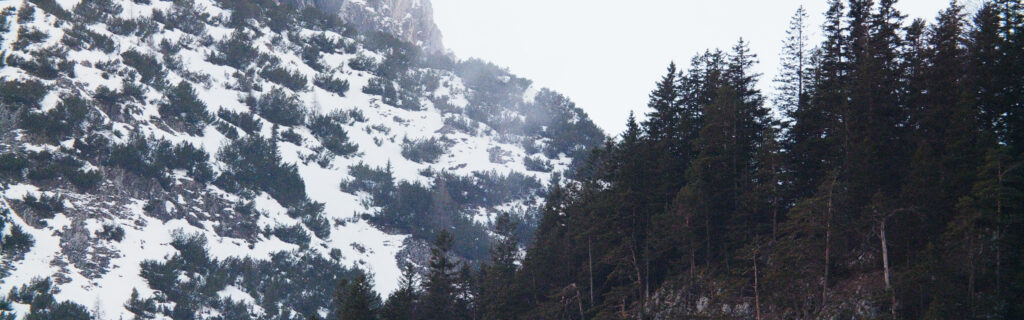
Amidst the stillness of the Bavarian forests, the landscape acts as a living archive of environmental history. It is a terrain defined by unseen boundaries and slow, subterranean migrations. Within this intricate ecosystem, the wild boar (Sus scrofa) exists as a central figure of entanglement, an animal whose constant digging into the earth’s crust bridges the gap between the atmospheric events of the past and the biological realities of the present.
The project explores these sedimented layers of radioactive life within a world of multispecies dependency. While traces of radioactivity in many forest organisms have slowly decreased since the 1986 Chernobyl disaster, the opposite is true for the wild boar. In several European regions, their radiation levels have experienced a significant upswing over the past decade (peaking at levels as high as 65,000 Bq/kg).
A Nuclear Love Affair
This ecological paradox serves as the conceptual core of this work, investigating why radiation levels in boars continue to surge while the rest of the forest shows a steady decline. This anomaly is rooted in the deep chemistry of the soil and the intricate web of multispecies relations. The installation invites viewers to descend into the subterranean world of the Bavarian forest to witness the invisible migration of Radiocesium-137 isotopes, remnants of both the 1986 Chernobyl disaster and decades of nuclear testing.
Central to this toxic legacy is the Deer truffle (Elaphomyces granulatus), a mycorrhizal fungus flourishing in the mineral-rich layers beneath mature pine, spruce, and beech trees. As radioactivity descends through the earth at an incredibly slow pace, it has only recently reached the specific depth where these truffles thrive. Through their expansive mycelia, the truffles absorb and accumulate radiocesium as if it were a nutrient, concentrating the isotope far more than other forest flora.
When wild boars forage in the winter, digging deep into these contaminated layers, they unknowingly participate in a subterranean “love affair” that has become an enduring toxic threat. Given the isotope’s 30-year half-life, this radioactive persistence is projected to haunt the forest food chain for at least a century.
Sensory Entanglements
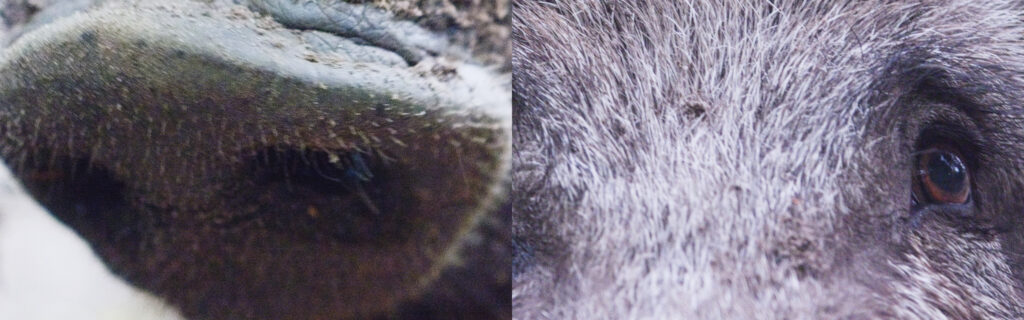
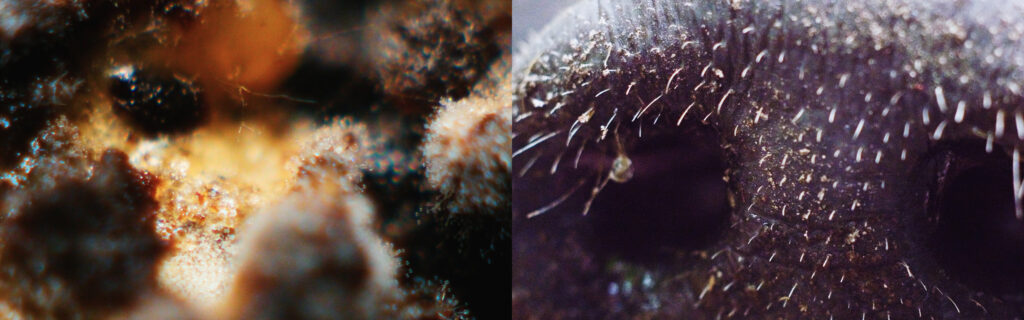
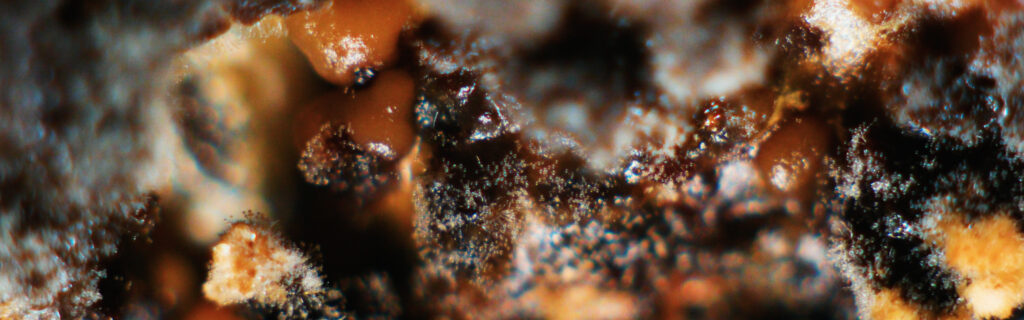
The project’s visual and sonic language is rooted in extensive fieldwork across the Netherlands and Germany, capturing the raw textures of a contaminated landscape through a lens of multispecies intimacy. Through a collaboration with BioArt Laboratories, the work incorporates intimate, non-human perspectives, utilizing extreme macro-cinematography to document the physical presence of the boar. These observations are juxtaposed with studio-recorded micro-timelapses of fungal growth, mapping the slow, relentless expansion of the mycelium.
Centrally, the sonic environment is constructed using custom-built equipment, including shotgun and contact microphones, to isolate the subtle movements and atmospheric pressures of the forest floor. This layered composition is anchored by a dual-language voice-over by Otto Calmeijer Meijburg, whose narration in English and German bridges the international scale of nuclear fallout with its deeply local, lived realities.
The Installation
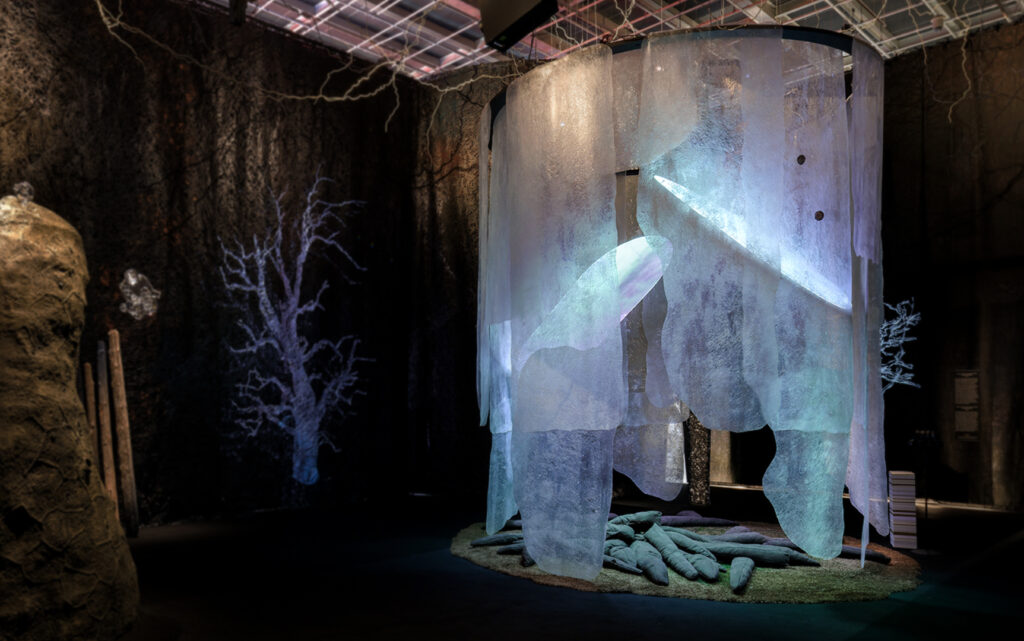
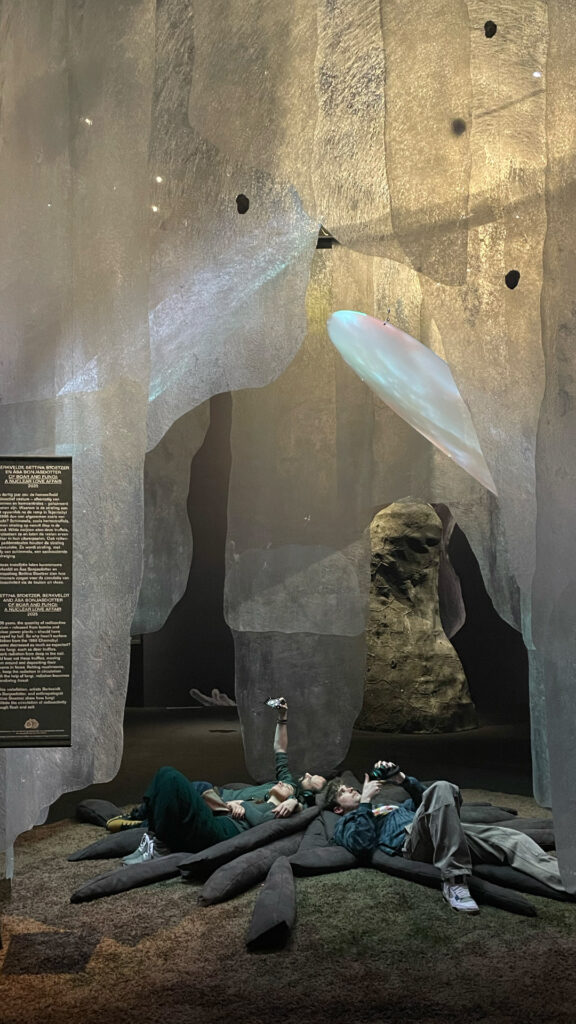
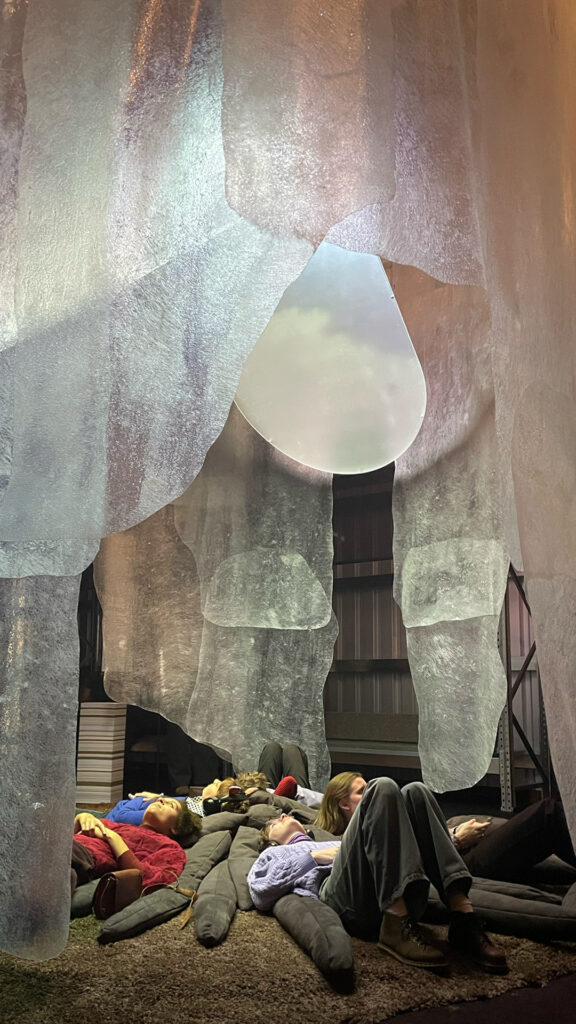
Of Boar and Fungi translates this research into an immersive scenography that invites a physical descent into a subterranean world where toxicity becomes a tangible, visceral experience. The installation features a large, hand-dyed carpet, a tactile visualization of the forest floor, enclosed by a handmade fiber curtain representing the intricate architecture of a mycelium structure.
Visitors are invited to lie down, resting on cushions that evoke the forms of subterranean roots. From this grounded perspective, looking upward through tilted, sandblasted screens, the viewer gazes “through” the earth at the visual narratives unfolding on and above the surface. The sandblasting technique causes the projected light to refract unpredictably; to see the work with sharp clarity, the visitor must physically enter and navigate the installation. This immersive positioning makes the “slow violence” of nuclear afterlives tangible, shifting the perspective from human oversight to an intimate engagement with the contaminated wild.
While in the installation, visitors are enveloped by a soundscape that mirrors the act of foraging, low-frequency rummaging and the tactile crunching of forest debris, interspersed with the cold, rhythmic ticking of a Geiger counter (an auditory reminder of the invisible 137-Cs presence). Visually, the work juxtaposes the organic textures of the Bavarian soil with generative digital layers, blurring the line between biological decay and radioactive persistence.
Ultimately, the work challenges the perception of nuclear risk as something contained in time or space, revealing instead how radiation blurs the boundaries between human bodies, animal kin, and their shared environments.
Acknowledgements
This project is the result of a multidisciplinary collaboration between Bettina Stoetzer, whose ethnographic research forms the foundation of the work, and artists Berkveldt and Åsa Sonjasdotter. The work was commissioned by Nieuwe Instituut for the exhibition FUNGI: Anarchist Designers, curated by Anna Tsing and Feifei Zhou.
Special thanks to curators Anna Tsing and Feifei Zhou, and the Nieuwe Instituut, for their invitation and guidance within the context of the exhibition FUNGI: Anarchist Designers.
Wild boar: Augustus Godfrieda de Eerste (BioArt Laboratories)
Voice-over: Otto Calmeijer Meijburg
Composition and sound design: Donát István Kuti